
Flicker study according to standard C.22-03

Flicker study according to C.22-03

Ensure your fluctuating loads comply with Hydro-Québec

The addition of new electrical loads, particularly high-power motors and industrial equipment with frequent starts, can generate voltage variations that cause flicker. These light fluctuations, which are visible to the human eye, can affect comfort, disrupt sensitive equipment, and, above all, exceed the thresholds set by Hydro-Québec.

For any connection project involving fluctuating loads, Hydro-Québec requires a flicker study to be carried out in accordance with standard C.22-03. At 3E Ing., we have the expertise to assess, simulate, and document the flicker level of your installations to ensure their compliance.
Why conduct a flicker study?

Flickering can have several impacts:

  • Visual discomfort caused by repetitive light variations;
  • Accelerated wear and tear on electrical equipment;
  • Risk of non-compliance with Hydro-Québec, which could delay a connection project;
  • Disruption for neighboring customers connected to the same grid.

A rigorous study can identify the most significant contributors (motors, compressors, shredders, saws, etc.) and propose mitigation solutions.

Our methodology

Our engineers apply the principles of standard C.22-03 and use specialized software and tools:

  • Inventory of fluctuating loads: motors >15 HP, welding systems, heating and lighting equipment.
  • Collection of actual data: power, start-up mode (full voltage, electronic starter, variable speed drive), operating frequency.
  • On-site measurements: recording of voltage and current variations to characterize the load profile.
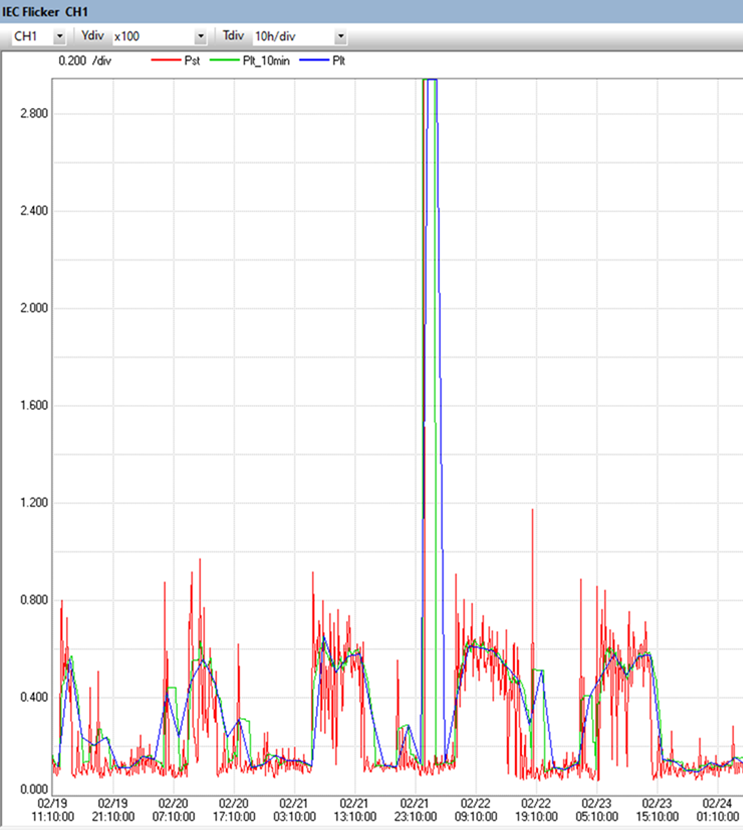
  • Advanced simulations: application of calculation methods defined by Hydro-Québec (methods 3 and 4 of standard C.22-03) to determine the Pst (short term) and Plt (long term) indices.
  • Analysis of results: comparison with the emission limits assigned by Hydro-Québec (EPst, EPlt).
  • Technical recommendations: addition of electronic starters (soft start), variable speed drives, start sequencing, or even resizing of certain loads.

Examples of achievements

We have assisted several industrial clients in the Quebec City, Chaudière-Appalaches, and Saguenay–Lac-Saint-Jean regions:

  • A sawmill equipped with more than 75 motors >15 HP, where our study showed that flicker levels remained well below the imposed limits.
  • A planing mill where the Pst initially exceeded the permitted thresholds; our recommendations to add electronic starters to 125 HP motors brought the facility into compliance.
  • A sawmill where measurements and simulations confirmed compliance without the need for additional corrective measures.

The advantages of working with 3E Eng.

The advantages of working with 3E Eng.

  • Guaranteed compliance with Hydro-Québec requirements.
  • Comprehensive reports accepted by HQ, clear and structured.
  • Concrete solutions tailored to the realities of your industrial operations.
  • Experienced team with recognized expertise in flickering studies and grid connection.

Contact us

Are you planning to add fluctuating loads to your facilities? Ensure that your project meets Hydro-Québec’s criteria with a professional flicker study.

Contact 3E Eng. today for a personalized assessment and a report that complies with standard C.22-03.

Flicker study conducted
These customers trust us